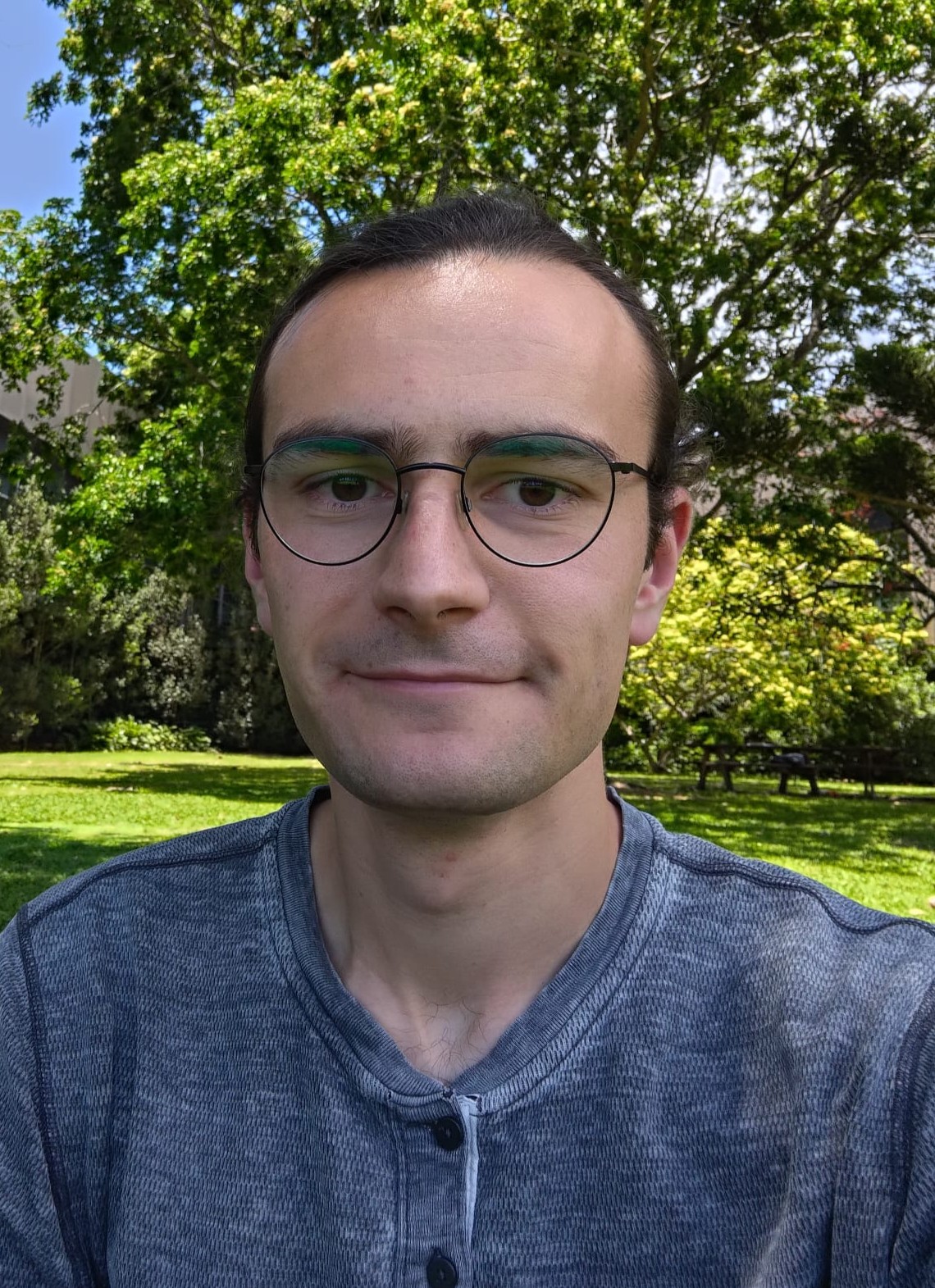
I did my Bachelor in biology at Bielefeld University (Germany), and a joint Master in evolutionary biology
at Uppsala University (Sweden) and the University of Groningen (Netherlands). I am currently doing
a PhD at the University of Queensland (Australia) on eco-evo interactions in duckweeds in the Hart Lab.
I find that scientists benefit from different ways of approaching and doing things, and to pick up different
approaches I have worked on ants, plants, songbirds, parrots, monkeys & humans driven by questions centering
around behavioural ecology, ancient DNA community reconstruction, human personality measurement and collective behaviour.
I draw inspiration from Kuhn's and Feyerabend's philosophy of science, which I interpret as a case
for pluralism of ideas and approaches in science. In the absence of a given reality for us to study, there is so much
room for us to play with different conceptualizations of the world that sticking to any one would be boring 😄
Current projects
Duckweed genetic population structure
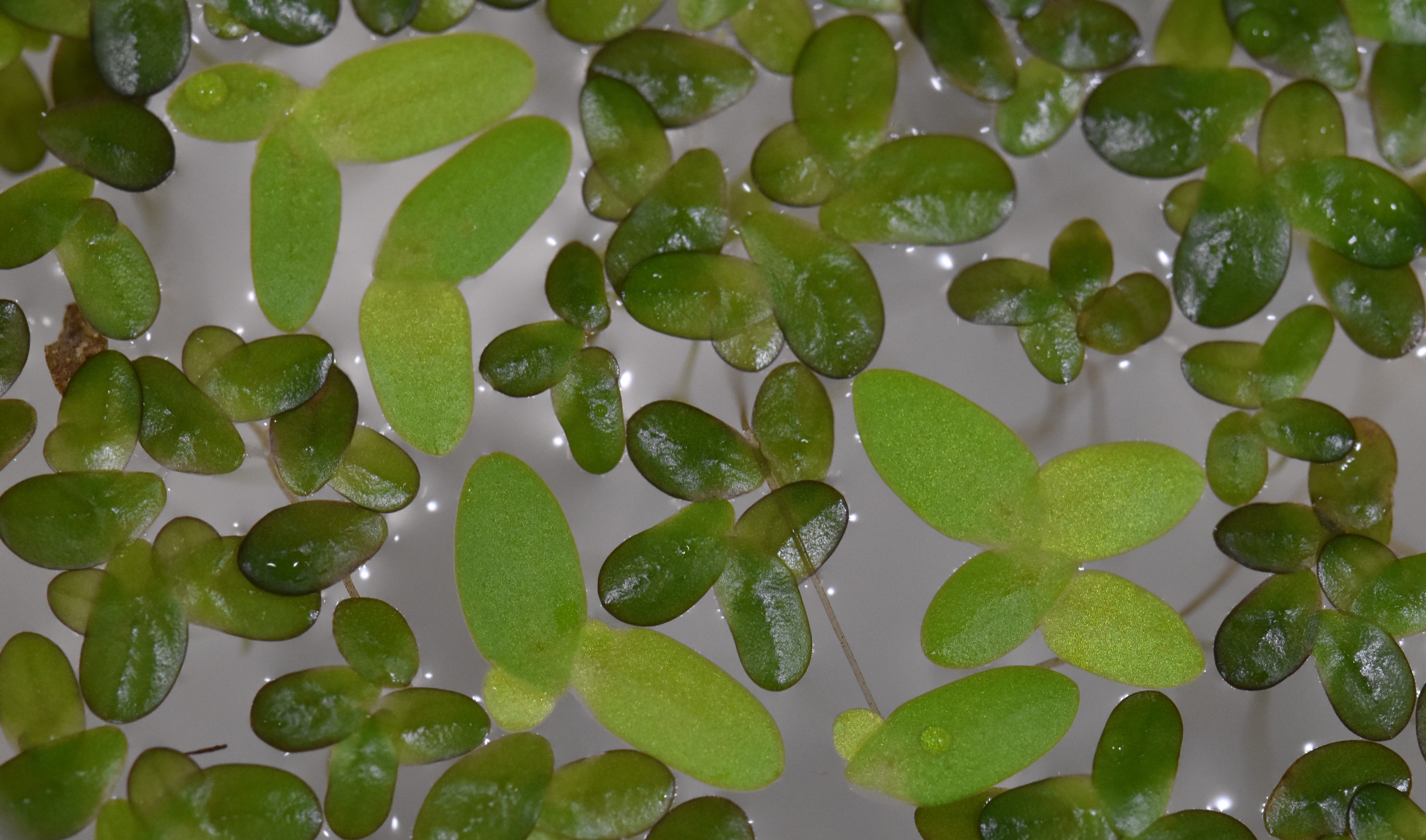
In my first PhD chapter, I am using a genotype-by-sequencing approach to investigate meta-population structure and multispecies
competitive environemnts of two local duckweed species Lemna aequinoctialis (light green) & Landoltia punctata (dark green).
Plasticity, selection, density and trait change
For the second and third chapters, I am conducting eco-evo duckweed experiments on duckweeds.
When genetic variation is fixed, individuals can change their traits via plasticity, and populations can change their
traits via selection among individuals (so far so evolution). At the same time, density shapes individual and population traits
(so far to ecology). I am using a density dependant trait to investigate how density mediates plasticity and selection to change traits of
individuals and populations.
Defintions of phenotypic plasticity
Spinning of from the empirical work, I am working on a conceptual project on different definitions of
phenotypic plasticity. The classic definition: "The ability of a given genotype to express different phenotypes in different environments"
is an umbrella definition housing several different definitions depending on how one defines genotype, phenotype, and environment.
My aim is to develop the different definitions of phenotypic plasticity into a resource for phenotypic plasticity research on a variety of
biological systems and questions.
Publications
Temizyürek, T., Richardson, G, B., Brown, G. Comparability of personality facets between men and women: A test of measurement invariance in IPIP-NEO facets in 49 countries. 2024. Journal of Research in Psychology, 113.
PDF
Temizyürek, T., Johannknecht, M., Korsten, P. Incubation before Clutch Completion Predicts Incubation Time and Hatching Asynchrony in the Blue Tit (Cyanistes caeruleus). 2022. Ardea, 110(2), 213-231.
PDF
Patlar, B., Weber, M., Temizyürek, T., & Ramm, S. A. Seminal Fluid-Mediated Manipulation of Post-mating Behavior in a Simultaneous Hermaphrodite. 2020. Current Biology, 30(1), 143-149.e4.
PDF
Miscellaneous
Book recommendations
The French Revolution a History, Carlyle (1857)
Rare genuine synthesis of literature and science
The Decline of the West, Spengler (1922)
A fully Kuhnian (philosophy of) history (includes a chapter on different mathematics)
The Great Chain of Being A Study of the History of an Idea, Lovejoy (1936)
Great science history, blueprint for Mayr's Growth of Biological Thought
Kulturgeschichte des Altertums, Friedell (1938)
Amazing reconstruction of ancient culture and thinking
On Understanding Science An Historical Approach, Conant (1947)
Makes you almost believe that the universities of the good old times really existed
The Elements of Style, Strunk & White (1959)
A short read on concise style
The Structure of Scienctific Revolutions, Kuhn (1962)
Amazing combination of being right but getting every detail wrong
Laboratory Life The Construction of Scientific Facts, Latour, Woolgar (1979)
Constructivist account of biology
The Growth of Biological Thought, Mayr (1982)
Traces diversity, evolution and inheritance through Western thought
Men of Mathematics, Bell (1986)
Collection of apparently questionable but nontheless meaningful biographies
Towards a new Philosophy of Biology, Mayr (1988)
The closest a scientist can come to philosophy before becoming a philosopher
Genius The Life and Science of Richard Feynman, Gleick (1992)
Including information of Feynman's approach to science
The Heretic in Darwin's Court The Life of Alfred Russel Wallace, Slotten (2004)
A warning that supernatural phenomena are best not be pursued rationally
Marie Curie A Biography, Ogilvie (2004)
Lays out Curie's exemplary science ethics
Science, Policy, and the Value-Free Ideal, Douglas (2009)
Shows that objective science is impossible and undesireable
The Price of Altruism George Price and the Search for the Origins of Kindness, Harman (2010)
"Might go hay-wire but will never be humdrum"
Crazy Like Us The Globalization of the American Psyche, Watters (2010)
Stark example of the tyrannical science Feyerabend warned about
Darwinian Populations and Natural Selection, Godfrey-Smith (2011)
Critizies definitions of evolution as just phenotypic variation, differential & heritable fitness
The Fall of the Faculty, Ginsberg (2011)
Polemic against administrative overload at universities
The Sixth Extinction An Unnatural History, Kolbert (2014)
Very good popular science writing
The Lost Elements, Costa, Fontani & Orna (2015)
On the discovery of the elements, including all the dead-ends
How to Tame a Fox (and Build a Dog), Dugatkin & Trut (2017)
Amazing long-term evolution experiment on fox domestication in the Soviet Union
There is no better way to make you feel uneducated (about history) than by reading Egon Friedell. He sets the standard for historical scholarship
in both comprehensivness of knowledge, and more importantly, in his ability to interpret history, thereby removing any distance that the
elapsed time has created. Somewhat infuriatingly, he also commanded the most beautiful German, using the language not just for transport,
but for the direct expression of ideas; he wrote poetry in prose. I have translated (the meaning, not the poetry) of two short chapters
that stayed with me from his Kulturgeschichte des Altertums (Cultural History of Antiquity),
you can download them here.
 I did my Bachelor in biology at Bielefeld University (Germany), and a joint Master in evolutionary biology
at Uppsala University (Sweden) and the University of Groningen (Netherlands). I am currently doing
a PhD at the University of Queensland (Australia) on eco-evo interactions in duckweeds in the Hart Lab.
I did my Bachelor in biology at Bielefeld University (Germany), and a joint Master in evolutionary biology
at Uppsala University (Sweden) and the University of Groningen (Netherlands). I am currently doing
a PhD at the University of Queensland (Australia) on eco-evo interactions in duckweeds in the Hart Lab.
 Duckweed genetic population structure